Wednesday, 16 April 2014

My Village


Welcome to the SilverWood Books Blog Hop!
A few of our authors have come together to share a variety of articles and items of interest on their blogs for your enjoyment. There are some lovely giveaway prizes, and - to stay in keeping with the Spring and rebirth theme at this time of year - some colourful Easter eggs. Feel free to collect the eggs, and use them where you like. They were drawn by SilverWood author Peter St John who writes the ‘Gang’ series about a boy who was evacuated to a village in East Anglia during WWII. Meet Peter and his characters on the Blog Hop, along with a host of eggcellent SilverWood authors. ;-)
Have fun!
Helen Hart
Publishing Director
SilverWood Books

Jennospot 118  Moi Village


Moi village o' Widdlin'ton ain't a big an' important place, 'cept fer them wot live there, o' 'corse, wot don't mean that there ain't no visitors from toime ter toime. Any'ow, a real noice lady from Pennsyvania, wot's in the United States o' America, come by recently an' she were kind enough ter write a piece about it (even although she din't say nuffink about me) but she did say somefink about a "Boy". Well, it jus' so 'appens that that "Boy" lives jus' in the back o' me, be'ind moi chicken run, an' cripes, Oi know all the trouble 'ee 'as wiv gangs, an' wiv 'is aunt an' all. This American lady's name is Katherine Ashe, http://wwwlongview.blogspot.com/ an' she writes super novels about English 'istory, so she really knows wot she's talkin' about. Any'ow, this is wot she wrote about the "Gang Territory" in Widdlin'ton:

"World War II and the bombing of London brought about the displacement of multitudes of children. We see photos of them, wan, frightened as they’re herded onto trains bound for the safer countryside or they’re led away by the firm grip of strangers’ hands. But what happened to them after that, when they arrived at their unfamiliar destinations?
Peter St. John’s autobiographically inspired story of a boy from a destroyed London orphanage gives us an insight. An insight not only into the new hazards such children faced, but into the noble code of boyhood, a code that forbade complaining when one was abused and that produced a degree of self-reliance that would serve well in later years – provided the noble spirited little lad survived.

As in a medieval romance, the hero’s name is never revealed to the reader. We will call him Boy. Boy arrives in the rural village of Widdlington which is scant of indoor plumbing but rich in gangs of children. Every street has its own gang who guard their territory from intruders. And an intruder is any other child who does not live on that street. This of course makes life exceedingly difficult for Boy, whose aunt and guardian seems oblivious to the juvenile culture surrounding her, for she makes a habit of sending him on errands where his very life depends upon his ingenuity in getting to his goal and back home again unobserved.

There may be individuals as completely lacking in humane feeling as this aunt, so completely focused on a sense of being put upon, so resentful of a young boy, and so determined to gain every instant of advantage from the unwanted presence of a child, as to resemble a slave driver with a savage tongue in place of whip. When the aunt seems to relent at sight of the boy’s injuries one senses that self-protection, not pity, is her foremost, driving motive: fear of being discovered as the abuser she is. Why is she so cramped and mean of spirit? Seen from the viewpoint of Boy, we never learn.

But if the aunt makes his new home hellish, the principal local bully, known as Slug, turns the entire outside world into a trial of strategy for Boy as he must navigate from place to place nearly always under the threat of severe bodily harm if he loses his focus of attention for a moment. St. John sets up hazards and triumphs that make the plot predictable but that also create suspense – and a certain admiration in the reader as we know what must be coming but well drawn intervening events keep forestalling the inevitable.

Widdlington is peopled with kindly folk as well as brutes: from teachers to parents to children – mostly girls – and the local derelict known as Dummy. Many speak in dialect although, thank heaven, Boy does not. As yet another “Oi” for “I” is uttered, the words of Henry Higgins spring to mind: “Why can’t the English teach their children how to speak?” Walter Scott loved writing in dialects too, so St. John is in illustrious company.
The issue of bullying is as timely now as ever and St. John’s exploration of the ways in which children cope: isolatedly, determinedly, with fear and bravery, is as resonant in Gang Territory as in Huckleberry Fin, and as a salutary reminder of obtuse adult perceptions and the complexity of the world of childhood."
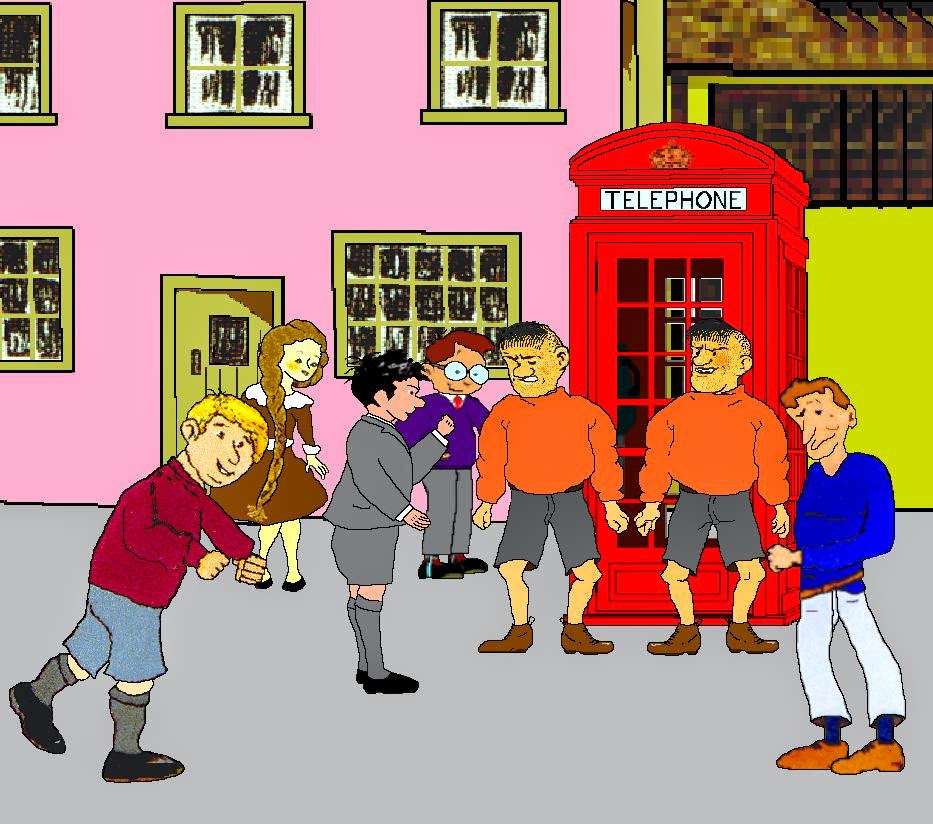
 

It's me, Jenno, wot put in the pictures of Widdlin'ton 'cos Oi thought yew'd loike ter see a bit o' moi village, so if'n yew don't loike 'em don't yew go a-blamin' the noice American lady. An' if p'raps yew'd loike a few more, yew c'd go ter http://www.peterstjohn.net/index
 By the way, the American lady reckons as 'ow a lot of us in Widdlin'ton speak wiv a dialect. Well Oi don't want ter be impolite, but ter moi ears its them Americans wot speak wiv a dialect. Any'ow, when Oi want, Oi c'n speak posh English just as well as Oi can proper English, only if'n Oi did it wiv moi gang around, they'd fink Oi gone all superior on 'em, an' they'd chuck me out. So Oi mostly don't do it. Oi'm glad ter 'ave cleared up that little point.

'Ave yerselves a real 'appy Easter.

Wiv luv from Jenno an' PStJ...

And there are a host of other exciting and interesting articles – hop forward to the next SilverWood Author for more interesting articles, some colourful Easter eggs to collect, and a few Giveaway Prizes:

·          Anna Belfrage : Is Freezing in a Garret a Prerequisite?
·        Lucienne Boyce : The Female Writer's Apology.
·        Isabel Burt : Friday Fruitfulness - Flees for the Easter Hop...
·        Caz Greenham : Springtime and Hanging Baskets.
·        Edward Hancox : Seaweed and Cocoa.
·        Matlock the Hare : Pig-padding the Self-published Highway...
·        Helen Hollick : Let us Talk of Many Things - Fictional Reality.
·        Alison Morton : Roma Nova - How the Romans Celebrated Spring.
·        John Rigg : Television Lines. - Television Lines.
·        Peter St John : Jenno Presents - My Village.
·        Michael Wills : A Doomed Army.
·        Debbie Young : Young By Nature - The Alchemy of Chocolate.
·        Helen Hart : SilverWood Books Spring Blog Hop.

And here is your Easter Egg to collect - there are six in all scattered throughout the Blog Hop - collect them all and feel free to use them on your own Blog or Facebook - or wherever you like!


Saturday, 29 March 2014

PStJ's Birfday


Jennospot 117  PStJ's Birfday

It's PStJ's birfday, an' the members of the "La Forge" Lit'ry Group took 'im out ter dinner. It weren't 'alf a barney. Well cripes, yew c'n tell can't yew, when Sally recited a poem wot she 'ad writ fer the occasion. An' 'ere it is, jus' fer fun. Well that's wot birfday parties are for, aint it? An' because o' that Oi ain't a-goin' ter try ter correct Sally's spellin' an' stuff; after all, that's wot the Lit'ry group is for, if'n yew see wot Oi mean…

Peter's Birthday

There once was a writer called Peter
Who liked poems with rhyme and with metre,
So at moments like this
Ginny fills him with bliss
And he's sure that no one can beat her.

A poem from Karin will move us,
And Rosalind's novel improve us,
Jules teases our brains,
Lesley writes of Great Danes (well poodles actually)
Peter's gang, of wartime manoeuvres.

Martha's family history's forthcoming,
Emanita to stage fame succumbing;
There's Leslie and Sanda
On Peter's veranda;
In her cradle is Amandine humming?

So the writers who meet at La Forge
Are meeting tonight just to gorge,
Celebrate a great day
When we all want to say:
Eat, drink and be merry just splurge. (Splorge?)

And let's raise a glass to toast Peter's
Birthday this year and repeaters.
Our thanks to our host
Who gives us the most
Of his time and his hospitality, and we'll make that rhyme another time…

'Appy birfday Peter, wiv love from Jenno... 


Cripes, Ginny 'as added anovver verse:
 
There’s someone left out of this tally
And that is our talented Sally
Her humorous verses
Delight and enchant us
Around Sally we “Forgers” all rally.
Thank yew, Ginny...

Tuesday, 18 March 2014

Ain't It Wunnerful?


Jennospot 116  Ain't It Wunnerful?

Cripes, ain't it wunnerful? There ain't no doubt about it. An' it don't matter wevver it's somefink wots jus' come new, or wevver it's over someone or somefink wot yew've known ever since the cows 'ave come 'ome an' been milked. There ain't nuffink really wot's better; leastways, Oi ain't found out yet wot it could be. Yeah, that's roight… Oi'm talkin' about love

Love is all about carin', an' sharin', an' about bein' there jus' a-grinnin' an' a-bearin'-up when fings don't go the way they oughtter. It's about bein' able ter say wot yew really fink, quite darin' like really, 'cos yew know that the person wot's listenin' wot get shirty at yew. An' it's about calmin' fings down when somebody starts bangin' around an' gettin' a bit 'ot under the collar. Cripes, love is getting out the cups, an' brewin' some tea, when somebody's feelin' a bit down; an' Oi don't mean when it's yew wot's down.

Love is when yew turn yerself inside-out an' upside down ter get over a problem wot somebody's 'aving, when it ain't really yer problem. 'Cos love c'n always make a way ter find the best in any kind o' situation.

Love is finkin' of ovvers, when yew'd rather fink of yerself. It's givin' out a smile, even when yew don't feel much loike smilin'.

Love makes a diff'rence ter somebody's day, if'n yew see wot Oi mean.

So 'ave yerself an 'appy day,

Wiv luv from Jenno


Monday, 24 February 2014

Moi Village o' Widdlin'ton


Jennospot 115  Widdlington

The village o' Widdlin'ton, where Oi live, is a noice little place; that is, if'n yew don't take too much notice of some of the people wot live there.

It's got a church, a chapel, a post office, a parish 'all, two pubs, a garage (wot ain't open 'cos of the war) an' six shops. The post office is run by Phoebe's muvver, but Phoebe an' me don't get along, so Oi ain't goin' ter show yew 'er picture.

The biggest shop in Widdlin'ton is Mr Hibberd's General Store. Mr Hibberd is a corporal in the 'Ome Guard, wot takes up a good bit of 'is toime nowadays, so 'is shop isn't always open. Still an' all, 'ee's mostly real obligin', 'cept that 'ee's always puttin' 'is spectacles down someplace where 'ee can't find 'em again. 'Ee don't see too good wivvout 'em.

There's over fings too, loike the Mill by the river, an' the Manor wot stands in a big private park. The Mill ain't workin' no more; not since the top bit got burned out jus' before the war, but there's a good swimmin' place just downstream of it.

Oi ought ter mention that there's two schools. Oi go ter one of 'em, wiv moi bruvver. The ovver one's fer the older kids, so Oi ain't goin' ter say nuffink more about it, not 'ere any'ow.

One of the pubs is called the Cock Inn. It's got a picture of a red rooster 'anging from a post by the front door. Whenever "Dummy" gets ter earn a shillin' or two, 'ee goes off ter The Cock, an' when 'ee comes out again, 'ee sometimes gets ter singin' an' shoutin' in The Street, wot gets 'im shut in the lock up fer a while.

The church is real old. It's called St Marys. There's a statue of 'er in a niche over the main porch. Yew wouldn't know it were 'er, 'cept that she's got a baby in 'er arms, cos she's been standin' up there so long, she's all worn away from the weather. Still an' all, she's the only one wot ain't lost 'er 'ead. 'cos there's lots o' ovver statues in various places around the church, but not one of 'em as got an 'ead. They say as 'ow it were Oliver Cromwell wot knocked their 'eads off four 'undred years ago, but wot 'ee 'ad against statues Oi dunno; after all, they're statues of saints, wot is more'n could be said of some o' them folk wot live in the village.

Any'ow, if'n yew'd loike ter know more about moi village, yew c'd always take a look at: http://www.peterstjohn.net/index_18.htm an' then yew c'd start clickin' around on the map. If'n yew want, that is. Yew c'd even come an' visit, but that'd take a bit more organising…


Thursday, 13 February 2014

Mountain Train


Jennospot 114  Mountain Train


By special request, Oi've been asked ter put a poem up on moi blog; so 'ere it is: It's by Peter St John. Oi 'ope yew loike it. Any'ow there's a noice picture...


Mountain Train


Chuffing upward from the plain

Skyward climbs the charm-like train;

Pinion tic tac on the rack.

Watch-like, clock-like, mounts the track;

Mountain goat with iron wheels;

Rounding bends with squeaks and squeals;

Tunnelling the buttress through:

Just another cheese to chew.

The valley seems a toy-town place

Seen from heaven's peer-down space.

Droll-doll chalets, sprinkled sparse,

Spick upon the cow-cud grass.


Tie by tie, the rails astride,

Ladder up the mountain side;

Thinly-lean, a two-pronged harrow,

Swissly-clean and spindly-narrow,

Parallel they never meet

Except... up in the sky, to greet

A Gruyère moon; looming there

In the crystal Swiss-wine air.

Or at the sun, join in one,

Fusing from a switchback run

 On an undulating way.


Pop-stop eardrums feel the rise;

We ride together to the skies.

No more trees; they're left behind...

High, the wind is too unkind.

Squeezing on a freezing bridge;

Ease along a heart-stop ridge;

Where peaks in this vicinity

Point us to infinity.

Down below all nods and plods:

At Heaven's portal we are gods.

And god-like, one would higher go;

Higher than the peaks and snow.


But... down one must towards the dust,

In wonder-lusting train unjust.

Entrusting Hope to justify

The return ticket from the sky.

The single strand now splits in two;

Divides One into me and you.

Down we rumble, charnel bundle...

Mindful as we earthwards trundle

Of rapture; but euphoria fails...

Fading on descending rails.

Below the air is thick.

Wednesday, 15 January 2014

The Essentials o' Cricket


Jennospot 113  The Essentials o’ Cricket

 Moi fav'rite book, wot's called "Gang Loyalty, 'as a lot in it about the English game o' cricket. P'raps there's some people readin' this, 'specially them wot live in America, wot ain't never played cricket so Oi thought Oi tell yew all about it 'ere. The trouble is, that cricket's easier ter play than wot it is ter describe.

 O' corse, all British boys are born knowin' all there is ter know about cricket. Fer girls it's different; they 'ave ter nut it out fer themselves. That's one reason wot accounts fer girls bein' so much more intelligent than boys.

 Any'ow, cricket is a bat an' ball game wot is played between two teams of eleven people, (wot is called a "side"). One side 'as a bat, an' the ovver side 'as a ball. Only yew can play wiv fewer than eleven, loike wot we often do, 'cos it ain't always easy ter get tergevver eleven kids wot want ter play. The game is usually played on grass, 'cept that, in the schoolyard, it's on gravely dirt, 'cos there ain't no grass, except along the edge of the wall, 'cos the caretaker ain't got no toime ter spare ter go pulling the grass out.

 The place where it's played is called the "Field" wot strictly speakin' ain't correct, 'cos a field is wot gets ploughed up, wot ain't cricket fer cricket, if'n yew get moi meanin'. Any'ow, in the middle o' this "field" yew knock in three sticks quite close ter one-anuvver, wot are called stumps, only they ain't really stumps 'cos they're quite long, about up ter yer waist. An' then, at the distance of a "chain" (wot is 22 yards in case yew don't know) yew knock in three ovver stumps. Only when we play, it ain't 22 yards, 'cos that's a bit long, 'specially fer the little-uns, so we usually judge it by eye; about 15 yards say. Not only that, if'n it's in the schoolyard an' it's too long, the ovver kids, wot ain't playin', often run across between the stumps, wot ain't good fer the concentration o' the players.

 When yew've got yer three stumps set up, it's called a "wicket". On top of the three stumps yew put two short sticks called "bails". Actually, it's them wot ought ter be called stumps, 'cos they're real short an' stumpy. Only they're called bails. They're there so's yew c'n tell when the

wicket 'as been 'it by the ball, 'cos then they fall off. Only we don't 'ardly never play wiv the bails on, 'cos they're a bit fiddly, an' always get lost. Besides the wind blows 'em off an' all, specially fer the girls, wiv their skirts. An' all that ain't got nuffink ter do wiv bein' bailed out.

 Any'ow, the team wot 'as the bat, puts a man in front of each wicket wiv a bat. Yeah, that person is still called a "man", even if'n it's a girl. Talk about discrimination! That there "man" 'as ter stand between the wicket an' a mark on the ground just in front of the wicket, wot's called the "crease". While, 'ee or she is in that little space, they're safe, an' can't be got out. Their job is ter defend the wicket, an' prevent it from bein' hit by the ball wot the ovver team 'as.

 P'raps Oi oughtta explain, than when we play, there ain't but one wicket, 'cos wiv just a few of us, ev'rybody plays just against the one wot 'as got the bat get it? An instead o' the ovver wicket, we put in only one stump, or even just a gas-mask box, ter mark the place.

 The side wot 'as got the ball, 'as the job o' sendin' it down from the ovver wicket (or gas-mask box accordin' ter circumstances) towards the one wiv the bat. That's called a "delivery". Only yew can't deliver the ball any ol' way wot yew loike; yew've got ter "bowl" it, or it don't count. Bowlin' means that yew got ter deliver the ball wiv a straight arm that goes over yer 'ead by the ear. If'n yew jus' throw it, it's called "chuckin'", an' the umpire calls "no ball". Only we don't never 'ave no umpire, wot can lead ter disputatious argument, wot ain't cricket. Any'ow, the one wiv the bat c'n still score off a no ball, even if'n 'ee can't be bowled out wiv one.

 The batsman or batswoman (wot ain't never called a "batter" by the way) c'n score by 'ittin' the ball, an' then runnin' as far as the ovver wicket (or gas-mask box), wot counts one run. If'n the ovver team gets ter the ball an throws it back ter 'it the wicket while the batswoman is between the crease an' the ovver wicket, then they're out, an' someone else c'n 'ave a go at battin'. They're also out if'n the ball wot the batsman 'its, is caught afore it 'its the ground. Oi 'ope that's clear.

 There's also some special scorin'. If the batsman (or woman) 'it's the ball ter the edge o' the "field" it's called a "boundary" an' counts four runs, but nobody 'as ter run, 'cept the person wot 'as ter go an' fetch the ball. If'n the ball goes ter the edge of the field afore it touches the ground, it counts six runs. O' corse, that don't 'appen very often.

 When we play in the schoolyard, there ain't no "field", properly speakin', but it counts as a boundary, if'n the ball goes as far as the wall. A six-'it, is a ball wot goes over the wall, loike inter the infants' schoolyard. But yew 'ave ter watch out 'ittin' inter the infants' yard, 'cos if'n it 'it's one o' the little-uns an' they make a fuss, yew c'n get clobbered by the 'eadteacher. Some o' the infants are liable ter make a fuss even if'n the ball don't go anywhere near 'em, 'cos that way they c'n get get sweets fer keepin' quiet; the little devils. So it's best not ter 'it any balls in that direction.

 So that's about all there is ter know about the essentials o' cricket. There's lotsa ovver rules natch, loike 'ow yew play when the wicket is chalked on the wall, but Oi reckon 'as 'ow Oi'v already covered the main points. If'n it ain't clear, yew c'n allus ask me fer details, or go ter any British boy; they're born wiv it, loike Oi said; even moi daft bruvver…

 Luv from Jenno.

 By the way, there's a few pictures of us playin' cricket in moi e-book, "Jenno's Widdlin'ton". It's free: http://www.smashwords.com/b/128813

 An' then there's Peter St John's books, specially "Gang Loyalty", wot 'as got quite a lot in it about cricket, an' ovver good sports an' all: http://www.amazon.com./dp/B0054DFQ2A or paperback http://www.amazon.co.uk/dp/1781321132.


Sunday, 5 January 2014

Yew're Real Special


Jennospot 112  Yew're Real Special
 
Sometimes the day begins wiv a clear mornin', an' be'ind all them little indoor sounds of life startin' up, it's all kind of quiet outside; loike when there's snow. That's when Oi reckon as 'ow it's a good toime ter  get a-hold o' the deep silence wot is be'ind all them little mischievous interferin' sounds o' livin'.

It's the moment when yew c'n find a sort of tremblin' space inside yerself, a sort of space wot yew c'n almost touch, wot yew c'n foller down an' down inside yerself, to where it's always silent, 'cept fer yer breathin' an' the beat of yer 'eart. It's the space where yew live; it's the space wot is really yew.

Fer me it's a roight quiet place, a still place. It's a place wot goes beyond sound, where Oi c'n be jus' me. It's where Oi c'n be jus' me wivvout no name, wivvout nuffink, except jus' me.

In that place, Oi c'n be 'appy just enjoyin' bein' wiv mesself. An' if'n Oi keep real still in this silent part o' mesself, Oi c'n start feelin' as 'ow strong Oi c'n be, 'cos Oi c'n fill mesself up wiv that kind of force wot comes from jus' bein' alive. Oi c'n fill mesself up wiv the sort o' power wot comes from the silence o' mesself an' from ev'ryfink else wot is.

When Oi'm in that place, Oi don't weigh nuffink; an' that's real relaxin' loike. When Oi'm in that place, Oi c'n know, wivvout really finkin' about it, wot a 'wunnerful creative sort o' fing Oi really am, 'cos Oi c'n touch ev'ryfink wot is, jus' by lookin' out from be'ind moi eyes. An' then Oi know that livin' is somefink wot is full of energy. An' when Oi know that, then evr'yfink starts lookin' new, jus' loike as though Oi were seein' it fer the very first toime; 'cept that it ain't the first toime, an' that makes it even better.

Cripes, then Oi know that Oi'm special, jus' loike wot everybody an' ev'ryfink else is Yeah, ev'ryfink's special. Yew too; real special…